ConditionsGeneral orthopedics
Fractures and sprains
After a twist or a hard hit, the question is always the same: did something break? A sprain is an injury to the ligaments — the 'straps' that keep the joint stable; a fracture is a broken bone. They feel similar at first, and telling them apart by eye is less reliable than people think.
Here's the practical rule that actually works: if you can't put weight on the limb or use it, if it looks deformed, or if the pain is right at one exact spot on the bone — that gets checked today, not 'let's see how it feels tomorrow.' Well-treated sprains heal without lasting problems; neglected ones keep sending you the bill for years.
2 minutes · free · no sign-up · or message me on WhatsApp
Common symptoms
- Immediate pain after a twist, hit, or fall
- Swelling that grows within minutes or hours
- A bruise that shows up over hours or days
- Trouble putting weight on the limb or using it — or not being able to at all
- Sharp pain when you press one spot on the bone, or a visible deformity
See yourself in several of these? In 2 minutes, measure how much it's limiting your zona and whether there are signs that shouldn't wait.
Start my free assessmentWhen to worry
These signs call for getting checked TODAY, not tomorrow:
- A visible deformity, or the limb looks crooked
- Can't put weight on it, or can't take four steps
- Fingers or toes that are cold, pale, or turning purple beyond the injury
- Intense pain at one exact spot on the bone
These signs shouldn't wait.
Treatment options
We always start with the simplest step.
Step 1
First hours: protect, ice, elevate
Stay off it, ice it for 15–20 minutes at a time, and keep the limb elevated. And the key decision: if any of the signs above are there, you get checked today — an X-ray now can save you weeks of the wrong treatment.
Step 2
Treatment matched to the injury
Sprains are graded, and treated with immobilization that matches the grade, plus early rehab — neither 'it's nothing' nor a month in an unnecessary cast. A stable fracture is immobilized for just the right amount of time, with checkups to make sure it's healing in the right position.
Step 3
Surgery when the bone calls for it
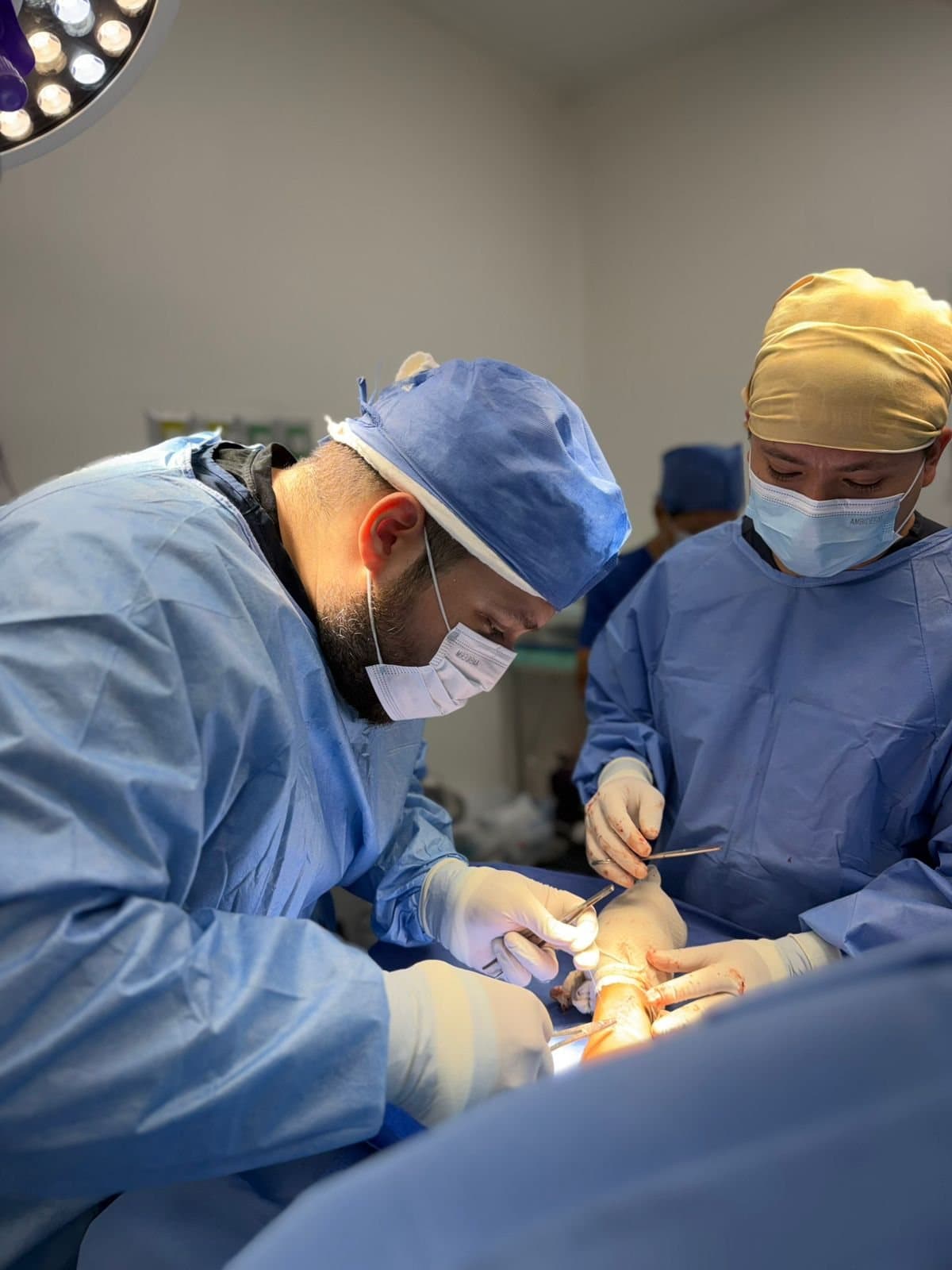
Displaced, unstable, or joint-involving fractures: we set them and secure them with plates and screws so the bone heals in its exact position. As an orthopedic surgeon, this is the heart of what I do — and doing the surgery right the first time is the best prevention of long-term problems.
How I treat it
«My job isn't done when the bone heals — it's done when you're using your limb again without thinking about it.»
Dr. Angel M. Ancona Pérez — Orthopedics & Spine Surgery
Prof. License 9552456 · Specialty License 12085805
In Mexico, my specialty is literally called "Traumatología y Ortopedia" — trauma is half the name. I treat fractures and sprains urgently, with a simple principle — classify precisely to treat exactly: X-rays in the right views, grading the injury, and a plan that matches it, from a functional brace to fixation surgery.
And I give rehab the credit it deserves: the cast or the surgery is half the treatment; getting back your motion, strength, and confidence is the other half. My job isn't done when the bone heals — it's done when you're using your limb again without thinking about it.
Frequently asked questions
How do I know if it's a sprain or a fracture without an X-ray?
With certainty, you don't — even doctors don't just guess by looking. There are clinical rules that point the way (being able to put weight on it, pinpoint pain on the bone), but the X-ray is what answers. If there's reasonable doubt, we take one: it's quick, accessible, and avoids the worst scenario — treating a fracture as if it were a sprain.
Can a poorly treated sprain really leave lasting problems?
Yes, and it's one of the most common things I see: ankles that twist 'on their own' every so often, chronic pain, instability. A ligament that heals too loose or too weak doesn't hold like it should. Sprain rehab is not optional — it's what decides whether this was a bad week or a lifelong problem.
Do the plates and screws come out later?
Not always. A lot of hardware can stay in for life without causing problems. It comes out when it bothers you, when it interferes with function, or in specific cases. It's an individual decision we make together once the bone has healed.
Could this help someone else?
Does this pain sound familiar?
Point to where you got hurt and see how much it's affecting you — in under 3 minutes — free, no sign-up.