ConditionsSpine
Slipped vertebra
Spondylolisthesis means one vertebra has slipped forward over the one below it. It can happen from wear and tear in the joints (most common in adults) or from a bone defect that dates back to adolescence.
Here's some good news up front: many slipped vertebrae never hurt and never cause any problems. When they do hurt, proper treatment starts with measuring the slip — not with panicking over the name.
2 minutes · free · no sign-up · or message me on WhatsApp
Zone: Lower back
Common symptoms
- Lower back pain that gets worse when standing or walking
- Relief when sitting or lying down
- Stiffness and a worn-out feeling in your lower back
- Pain running down your legs if a nerve is being pinched
- In some cases, a small 'step' you can feel in your lower back
See yourself in several of these? In 2 minutes, measure how much it's limiting your lower back and whether there are signs that shouldn't wait.
Start my free assessmentWhen to worry
- Weakness in the legs that keeps getting worse
- Numbness in the genital area, or new difficulty controlling your bladder or bowels
- Pain that gets worse quickly over a matter of weeks
These signs shouldn't wait.
Treatment options
We always start with the simplest step.
Step 1
Conservative (non-surgical) treatment
Strengthening your spine's natural 'corset' (your core and back muscles) with targeted physical therapy, plus medication during flare-ups. It works in the vast majority of stable cases.
Step 2
Monitoring with imaging
In low-grade slips, measuring and comparing over time is part of the treatment: most don't progress.
Step 3
Fusion surgery
When there's proven instability, progression, or nerve compression that doesn't respond. It secures the slipping segment in place — depending on your case, with minimally invasive percutaneous instrumentation.
How I treat it
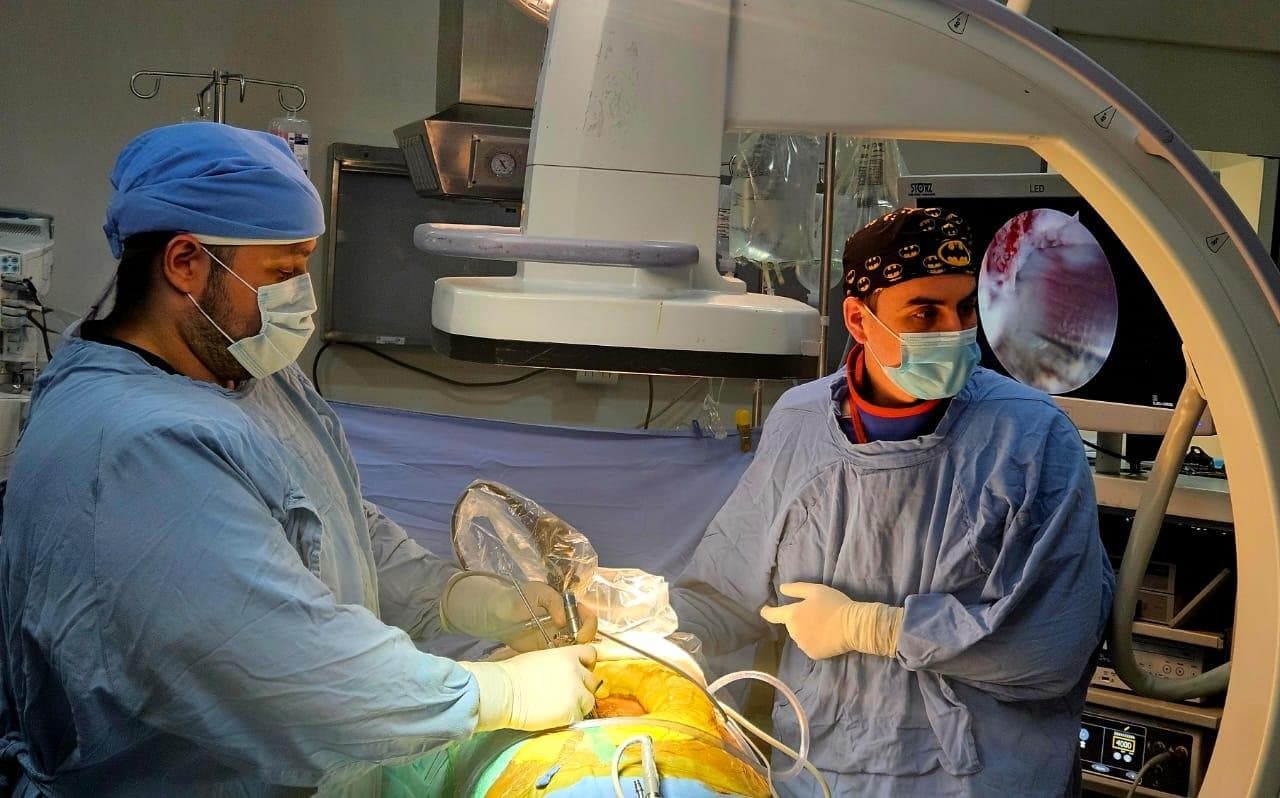
«I operate on what truly warrants it: instability and compression — not a scan or a scare. That standard is what protects you — and when surgery is necessary, I do it with minimally invasive instrumentation.»
Dr. Angel M. Ancona Pérez — Orthopedics & Spine Surgery
Prof. License 9552456 · Specialty License 12085805
The first step is classifying your case: how far the vertebra has slipped (the grade), whether it moves when you move (stability), and whether it's pinching any nerves. Those three answers — which come from the exam and from X-rays taken while you bend — define everything else.
My bar for surgery here is high: I operate on instability and compression — not on a scan or a scare. Most of my spondylolisthesis patients are treated without surgery, with follow-ups that measure the slip over time.
Frequently asked questions
Can a chiropractor 'put my vertebra back in place'?
No — the slip is structural and can't be pushed back into place from the outside. In an unstable spine, forceful manipulation can even be risky. Treatment means strengthening, monitoring, and — only if truly needed — fusion surgery.
Can I exercise with spondylolisthesis?
In most cases, not only can you — you should. Muscle is your best stabilizer. What changes is the type of exercise — we design it around your grade and your stability.
Does it always end in surgery?
No. Low-grade, stable slips — and that's most of them — can be managed without surgery for life. Surgery is for cases with instability or progressive compression.
Could this help someone else?
Does this pain sound familiar?
See how much your back pain is affecting you — in under 3 minutes — free, no sign-up.